
On this page
What do most Bremerton homes get?
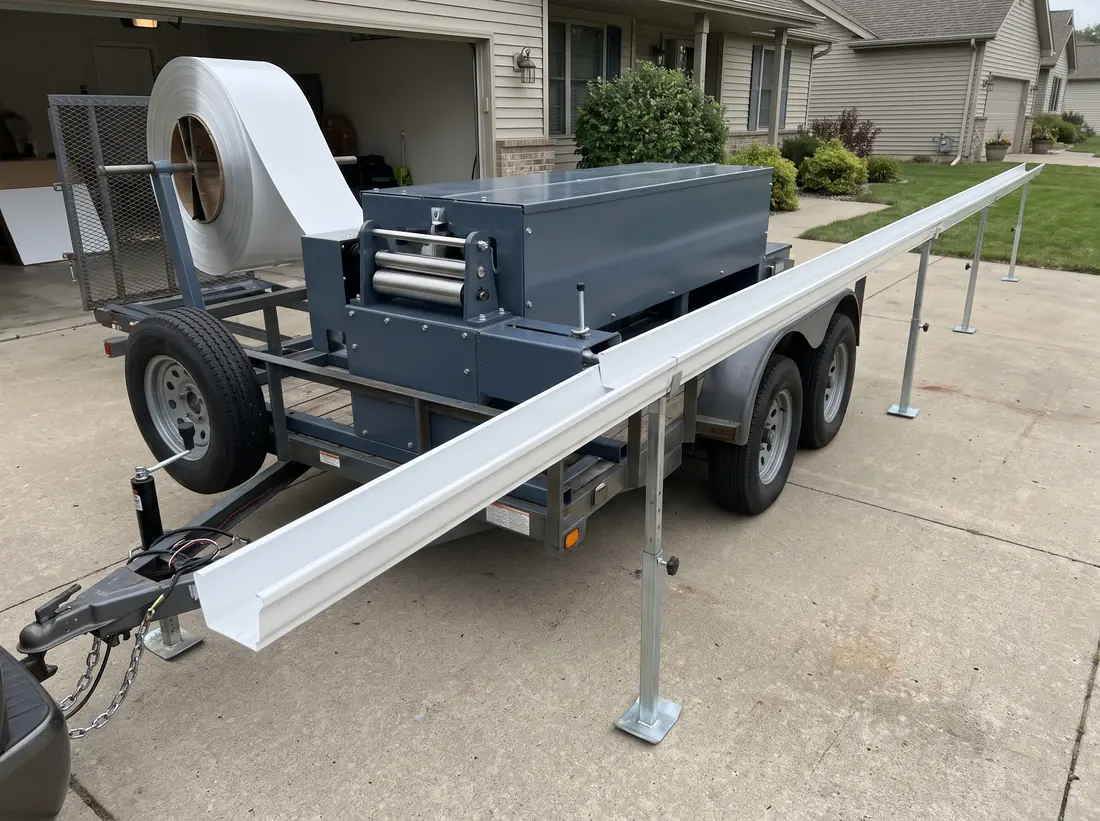
Seamless aluminum in the K-style shape, 5 or 6 inches wide, with rectangular downspouts. The installer brings painted coil and a forming machine, and every run is made to the length of its wall.
| Choice | Usual pick here | When to pick something else |
|---|---|---|
| Profile | K-style | Early 1900s houses with open rafter tails often look right in half-round |
| Width | 5-inch | Steep roofs, valleys, long upper planes or metal roofing: 6-inch |
| Metal | Aluminum, 0.032 inch | Waterfront or period homes may suit copper |
| Joints | Seamless | A shed or carport the truck cannot get near |
| Downspouts | 2x3 on 5-inch, 3x4 on 6-inch | Under firs and maples, 3x4 throughout. See downspouts |
How is a new gutter installed?
- Measure and plan. Each eave is measured. Outlets go where water can be led away from the foundation, not toward a slope that runs back to the house.
- Test the wood. The fascia is probed end to end. In this climate, rot behind old gutters is common, and soft board is replaced first.
- Check the roof edge. A gutter apron goes under the shingles where there is no drip edge, so water cannot run down behind the gutter.
- Form the runs. Coil goes through the machine and comes out at the exact length of the wall.
- Fit outlets and ends on the ground. Drops are cut in and sealed, end caps crimped and sealed.
- Hang it. Hidden hangers go in every two feet, closer under heavy trees, along a line that falls about a quarter inch per ten feet.
- Join the corners. Miters are cut, riveted and sealed inside.
- Run the downspouts. Pipe and elbows are strapped to the wall and led to an extension, splash block or tightline.
- Prove it. A hose at the high end shows water reaching every outlet with nothing standing.
What does the Kitsap climate ask of a gutter?
Long wet seasons. Bremerton averages about 57 inches a year, and December alone brings close to 10 inches. Rain often falls for days without a break. Joints stay wet for months, so fewer joints and good sealant matter.
Trees on every side. Douglas fir and western red cedar drop needles all year. Bigleaf maple and red alder drop big leaves in fall. Needles slip past cheap guards and knit into mats at outlets. See evergreen trees and gutters.
Moss. Shaded roofs grow moss that sheds into the gutter, holds water and blocks drops. See moss and gutters.
Wind. Winter storms bring strong gusts. In the Hanukkah Eve windstorm of 2006, interior gusts reached 50 to 80 mph and more, and limbs came down across the region. Hangers at close spacing and downspout straps every few feet hold up best.
Hills and wet ground. Many lots slope toward the water. A downspout that empties onto a slope can wash it out, or send water back under the house. See downspout drainage.
Salt air. Homes on Sinclair Inlet, Dyes Inlet, Liberty Bay and the Sound need fasteners and metals that cope with it. See gutters near salt water.
What size suits my house?
| House | Gutter | Downspouts |
|---|---|---|
| Single-storey rambler, low roof | 5-inch K-style | 2x3, one per 30 to 40 feet |
| Rambler under firs and maples | 5-inch, 0.032 inch | 3x4 with wide outlets |
| Split-level on a slope | 5-inch, 6-inch on the long upper roof | 3x4 to a tightline |
| Two-storey with valleys | 6-inch on valley runs | 3x4 next to each valley |
| Early 1900s home with open eaves | 6-inch half-round | 3 or 4-inch round |
| Shop or barn with metal roofing | 6-inch or box gutter | 3x4 or larger |
What does it cost?
National ranges from Angi and This Old House put 5-inch seamless aluminum at roughly $9 to $14 per installed foot and 6-inch at $11 to $17. Nobody publishes Kitsap-only figures, so treat those as a benchmark rather than a quote. Steep lots, tall walls, fascia replacement and guards all add. The Bremerton cost guide works through examples.
What should the quote list?
- The contractor's Washington L&I registration number
- Feet of gutter and number of downspouts
- Profile, width, metal and thickness
- Colors
- Hanger type and spacing
- Corner type
- Where each downspout will drain, and any tightlines
- Removal and disposal of old gutters
- A per-foot rate for fascia replacement
- Guards, if included, by type and brand
- Payment schedule
Does the contractor need to be registered?
Yes. Washington requires every construction contractor to register with L&I and to be bonded and insured. There is no small-job exemption for installation or repair. Check the registration before you sign. Permits are rarely needed for gutters, but connecting downspouts to a storm system or changing drainage can involve the City of Bremerton, the city you live in or Kitsap County.
When is the best time to install?
Late spring through early fall, when fascia is dry and sealant cures well. Crews fill up fast once the first fall storms show which gutters are failing.
Parts of a gutter system
| Term | Plain meaning |
|---|---|
| K-style | The everyday gutter profile, flat at the back with a decorative front. Also called ogee |
| Half-round | A semicircular gutter, the norm on houses built before about 1940 |
| Coil | The roll of painted sheet metal that the seamless machine shapes into gutter |
| Fascia | The trim board capping the rafter ends, and the thing your gutter is screwed to |
| Drip edge | A strip of bent metal under the first row of shingles. Its lip throws runoff clear of the board and into the trough |
| Gutter apron | Flashing with a long leg under the shingles and a short leg dropping inside the gutter, so nothing runs down behind |
| Hidden hanger | A metal bracket that hooks under the gutter lip and is driven into the fascia with a long screw, out of sight |
| Hand-cut miter | A corner shaped on site from the gutter itself, riveted and sealed, with one joint |
| End cap | The closure at the end of a run |
| Outlet | The hole and short tube in the gutter floor where water drops into the downspout |
| Elbow | An angled fitting on a downspout. A-style bends toward or away from the wall; B-style bends along it |
| Downspout | The vertical pipe taking water down from the gutter. Often called a leader |
| Strap | A band holding the downspout against the wall |
| Tightline | A buried solid pipe taking roof water to an approved outlet away from the house |
| Fall | The gentle downhill slope built into a gutter, roughly a quarter inch every ten feet |