
On this page
- Does Bremerton's rain call for 6-inch gutters?
- Which roofs outgrow a 5-inch gutter?
- How is a run sized?
- Why must the downspout grow too?
- Where on the peninsula is 6-inch common?
- How can I tell my gutters are too small?
- Must every side go to 6-inch?
- What does it cost?
- Does 6-inch need anything extra?
- What should the quote spell out?
- Does the installer need to be registered?
- Parts in a 6-inch system
- Can I upsize one run later?
- Does a split-level need 6-inch?
- How do I check the contractor?
Does Bremerton's rain call for 6-inch gutters?
Not across the board. Bremerton gets roughly 57 inches of precipitation a year, but intense bursts are less common than in many US cities. What overloads a gutter here is a large or steep roof feeding a short run, a valley pouring onto one corner, or a debris-choked outlet. A typical rambler is fine with 5-inch. Bigger and steeper roofs are where 6-inch helps.
Which roofs outgrow a 5-inch gutter?
| Roof feature | What happens with 5-inch |
|---|---|
| Steep pitch | Water arrives fast and can jump the front lip |
| Long single plane | A lot of roof feeding each foot of gutter |
| Valley | Two planes empty onto a few feet of gutter |
| Upper roof draining onto a lower one | The lower gutter carries both |
| Metal roof | Sheds faster than shingles |
| Heavy tree cover | Debris narrows the outlet, so spare capacity matters |
How is a run sized?
- Measure the plan area of roof that drains to the run
- Allow for pitch
- Check what one downspout can carry
- Add outlets before widening, where the run allows
- Choose 6-inch for runs that still fall short
As a rule of thumb, a 2x3 downspout handles about 600 square feet of roof and a 3x4 about twice that.
| Roof area to one run | Gutter | Downspouts |
|---|---|---|
| Under 600 sq ft | 5-inch | One 2x3 |
| 600 to 1,200 sq ft | 5-inch with two outlets, or 6-inch | Two 2x3 or one 3x4 |
| Over 1,200 sq ft | 6-inch | One 3x4 per 1,200 sq ft |
| Below a valley | 6-inch | A 3x4 near the valley |
Why must the downspout grow too?
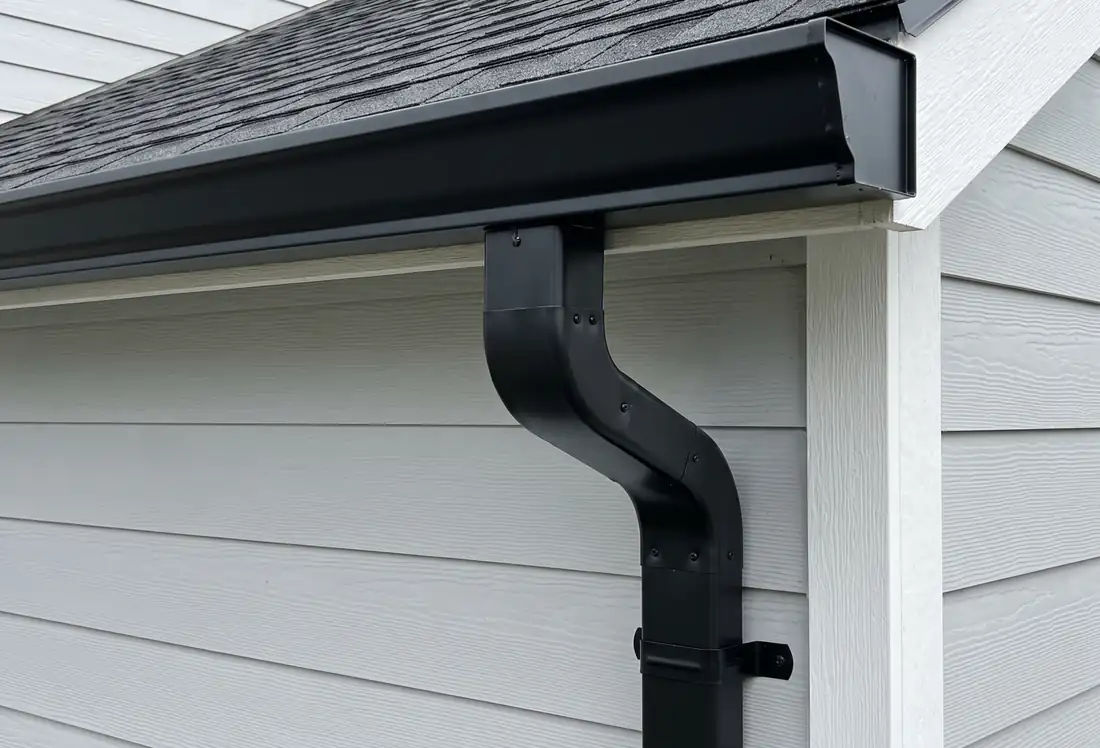
Extra width only buys storage. Everything still has to leave through the pipe, and a 6-inch trough feeding a 2x3 spills as soon as that pipe is full. Stepping up to 3x4 roughly doubles the flow and lets cones and big maple leaves through. Change both at once.
Where on the peninsula is 6-inch common?
On two-storey homes with steep gables in Silverdale, Port Orchard, Poulsbo and Gig Harbor. On large custom homes on Bainbridge Island and along the water. On long upper roofs of split-levels. On metal-roofed shops and barns. Most single-storey ramblers do not need it.
How can I tell my gutters are too small?
Rule out debris first by having them cleaned. Then watch them in a downpour, or put a hose on full at the top of each run. Size is the problem if water rolls over the whole length, shoots past below a valley, or spills while the downspout is already running flat out. Muddy splash lines and a trench in the bed below tell the same story.
Must every side go to 6-inch?
No. Most houses mix sizes, changing at a corner.
What does it cost?
National guides put 6-inch seamless aluminum at about $11 to $17 a foot installed, against $9 to $14 for 5-inch. On one 35-foot rear run, the difference is modest.
Does 6-inch need anything extra?
It holds more water and debris, so it weighs more when full. Hidden hangers every two feet or closer into sound wood, and 0.032-inch coil to keep the lip stiff. The fascia must be deep enough for the taller gutter back.
What should the quote spell out?
- Which runs change size, and why
- Downspout size and count per run
- Coil thickness
- Hanger spacing
- Valley diverters
- Guard type, if any, in the 6-inch width
Does the installer need to be registered?
Washington requires every construction contractor to register with L&I and carry a bond and insurance, with no exemption for small jobs. Look up the registration before you sign.
More in 5-inch vs 6-inch gutters.
Parts in a 6-inch system
| Term | Plain meaning |
|---|---|
| K-style | The everyday gutter profile, flat at the back with a decorative front. Also called ogee |
| Outlet | The hole and short tube in the gutter floor where water drops into the downspout |
| Downspout | The vertical pipe taking water down from the gutter. Often called a leader |
| Elbow | An angled fitting on a downspout. A-style bends toward or away from the wall; B-style bends along it |
| Valley diverter | A small metal fin where a valley meets the gutter, breaking up the stream so it does not overshoot |
| Hidden hanger | A metal bracket that hooks under the gutter lip and is driven into the fascia with a long screw, out of sight |
| Fascia | The trim board capping the rafter ends, and the thing your gutter is screwed to |
| Gauge | How thick the metal is. Aluminum house gutter is 0.027 or 0.032 inch; copper is sold as 16 or 20 ounce |
Can I upsize one run later?
Yes. A single run can be replaced with 6-inch and joined to 5-inch at a corner with a transition. Most contractors plan size changes at corners.
Does a split-level need 6-inch?
Often on the lower run where the upper roof drains onto it. Alternatively, a downspout from the upper gutter can be led past the lower roof to the ground.
How do I check the contractor?
Ask for the Washington L&I registration number, look it up on L&I's verify tool, and ask for a certificate of insurance. Get the scope and price in writing before work starts, and pay in stages rather than all up front.