
On this page
What is my gutter telling me?
| What you see | Likely reason | Read more |
|---|---|---|
| Drips at a corner or end | Sealant failed after months of wet | Leaking gutters |
| Water over the front edge | Needles and moss at the outlet, too few downspouts, or too small a gutter | Overflowing gutters |
| A run dipping or leaning out | Loose spikes, rotten fascia, wet debris weight | Sagging gutters |
| Stained or soft board behind the gutter | Water running behind for years | Fascia and soffit |
| Downspout blocked, loose or crushed | Needles, cones, knocks, failed straps | Downspout repair |
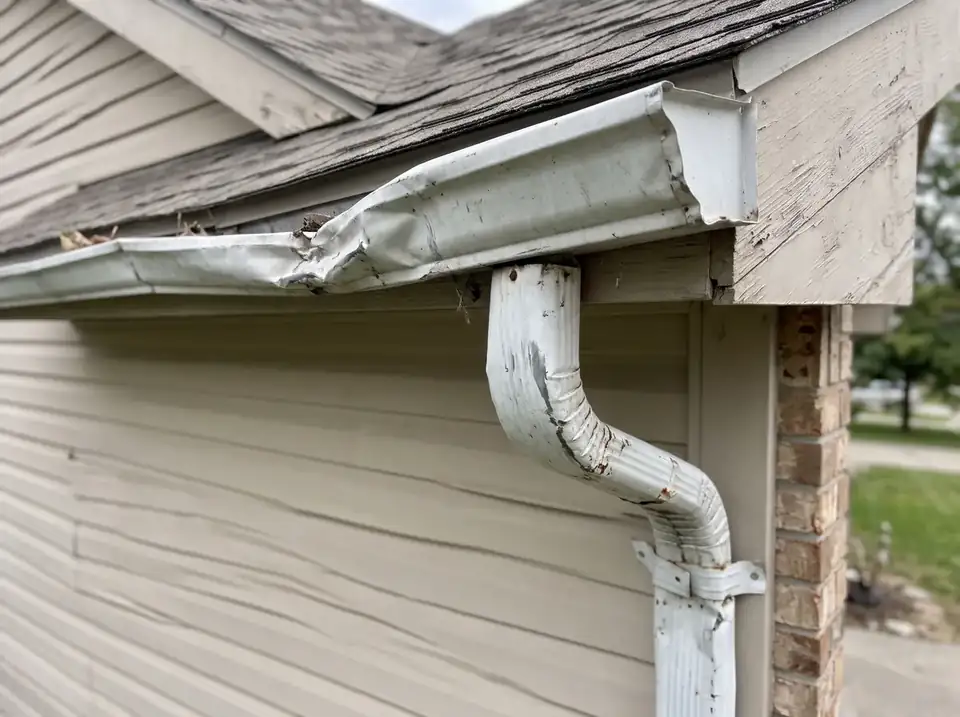
| Creases or a run down after a storm | Limbs and wind | Wind and storm damage |
Tap the symptom closest to yours.
Water pours over the front edge in a steady rain
On the Kitsap Peninsula the usual culprit is a plugged outlet: fir needles, maple leaves and moss knit into a mat at the downspout. Sometimes the run has sagged and holds water in the middle, or a steep roof is outrunning a 5-inch trough. Clear the outlet, check the line with a level, then think about size. See overflowing gutters.
Moss or plants growing along the gutter
Moss on the roof sheds clumps and spores into the gutter, where they hold water and grow. It blocks outlets and keeps the fascia wet. Clean the gutter, and talk to a roofer about the roof moss itself. See moss and gutters.
Dripping at a corner or the end of a run
The sealant at that joint has failed. In this climate, joints that stay wet for months break down faster. The old sealant is cut out and the joint resealed on a dry day. See leak repair.
A run sagging or pulling off the fascia
Old spikes have worked loose, supports are too far apart, or the board behind has rotted. Wet needles and moss are heavy. Soft wood is replaced, then the run is re-hung on screws. See sagging gutters and fascia repair.
Damage after a windstorm or a falling limb
Kitsap's tall firs drop limbs in winter wind. Creased lengths and torn downspouts are replaced, not bent back. The storm damage page covers what to photograph.
Water pooling by the foundation or the crawl space
A downspout is letting go too close, or a buried line has silted up or been crushed. On slopes, water can also run back toward the house. See downspout repair and drainage.
How does a repair visit go?
- The gutter is emptied, since needles and moss hide faults
- A hose shows where water goes and where it stops
- A level along each run checks the fall
- Hangers are tested and the fascia probed
- The cause is fixed: reseal, re-hang, new section, extra outlet or new wood
- Water runs again to confirm
Why do gutters fail on the peninsula?
Constant wet. With about 57 inches a year, sealant and wood are rarely dry from fall to spring. Joints that would last a decade in a dry climate fail sooner.
Heavy debris. Wet fir needles, maple leaves and moss make a dense, heavy mat. It blocks outlets, holds water against the fascia and pulls on hangers.
Wind and limbs. Tall trees shed limbs in winter storms. One limb can crease a run or tear a downspout off.
Rot behind the gutter. Water that runs behind the gutter or drips from a joint keeps the fascia wet for months. Rotten board stops holding hangers.
Slopes. Downspouts on hillsides get knocked, buried by sliding soil or emptied onto ground that sends water back.
Repair or replace?
| Finding | Sensible response |
|---|---|
| A couple of dripping corners on straight metal | Reseal |
| A run pulled loose, wood still sound | Re-hang on hidden hangers |
| One creased length | Replace that length |
| Fascia soft along a wall | New board, usually new gutter on that wall |
| Old sectional gutter leaking at every seam | Replace with seamless |
| Gutter too small for the roof, overflows when clean | Replace with 6-inch or add outlets |
More in repair or replace.
What do repairs cost?
No local price list is published. Cost follows time on site, wall height and how steep the lot is.
| Job | Relative cost |
|---|---|
| Reseal a corner | Low |
| Clear a blocked downspout | Low |
| Re-hang a run | Low to medium |
| Add a downspout | Low to medium |
| Replace a section | Medium |
| Fascia replacement and re-hang | Medium to high |
| Second-storey or steep-lot work | Higher, for access and safety |
Ask for each item to be priced separately.
Does a repair contractor need to be registered?
Yes. Washington requires registration with L&I for construction work, repairs included, regardless of job size. Verify it. L&I lists gutter cleaning on its own as a service that does not need registration, so someone who only cleans may not be registered and cannot legally do repairs.
Which repairs can I do myself?
With a helper, a standoff and a single-storey eave, plenty is within reach: pulling a plug from an outlet, resealing a low corner in dry weather, replacing a spike with a hanger, reattaching a strap. Tall walls, steep ground and anything near overhead lines are contractor territory.
What can I check before calling?
On a dry day, look along each run for dips, look for dark streaks under corners, check the fascia for peeling paint or green growth, and see where each downspout ends. In the next downpour, take a short video of any spill.
Which repairs cannot wait?
- A run hanging by one end
- Water getting into the eave, a window or the house
- Water pooling against the foundation or in the crawl space
- A downspout emptying onto a slope that is starting to wash
- Outlets blocked with a big front on the way
Parts a repair can involve
| Term | Plain meaning |
|---|---|
| Hidden hanger | A metal bracket that hooks under the gutter lip and is driven into the fascia with a long screw, out of sight |
| Spike and ferrule | The old fixing: a long nail through a sleeve, straight through the gutter face. It loosens in wet wood |
| Fascia | The trim board capping the rafter ends, and the thing your gutter is screwed to |
| Soffit | The panel or boards closing the underside of the eave |
| Drip edge | A strip of bent metal under the first row of shingles. Its lip throws runoff clear of the board and into the trough |
| Gutter apron | Flashing with a long leg under the shingles and a short leg dropping inside the gutter, so nothing runs down behind |
| Strip miter | A corner made of two angled cuts, held together by a cover strip |
| End cap | The closure at the end of a run |
| Outlet | The hole and short tube in the gutter floor where water drops into the downspout |
| Elbow | An angled fitting on a downspout. A-style bends toward or away from the wall; B-style bends along it |
| Strap | A band holding the downspout against the wall |
| Sealant | The flexible bead inside each joint. Months of wet break it down |
| Moss | The green growth on damp, shaded roofs here. It sheds clumps that dam gutters |