
On this page
- Which homes suit half-round?
- How is half-round different from K-style?
- How is half-round hung?
- What size?
- Which metal?
- What about old roof edges?
- How does half-round cope with fir needles?
- Do historic listings matter?
- How much does it cost?
- Exposed brackets or hidden hangers?
- Can I mix half-round and K-style?
- What should a half-round quote say?
- Does the installer need to be registered?
- Half-round gutter terms
- How are round downspouts finished at the bottom?
- What about houses with cedar shingle roofs?
- Is half-round right for a waterfront home?
- How do I check the contractor?
Which homes suit half-round?
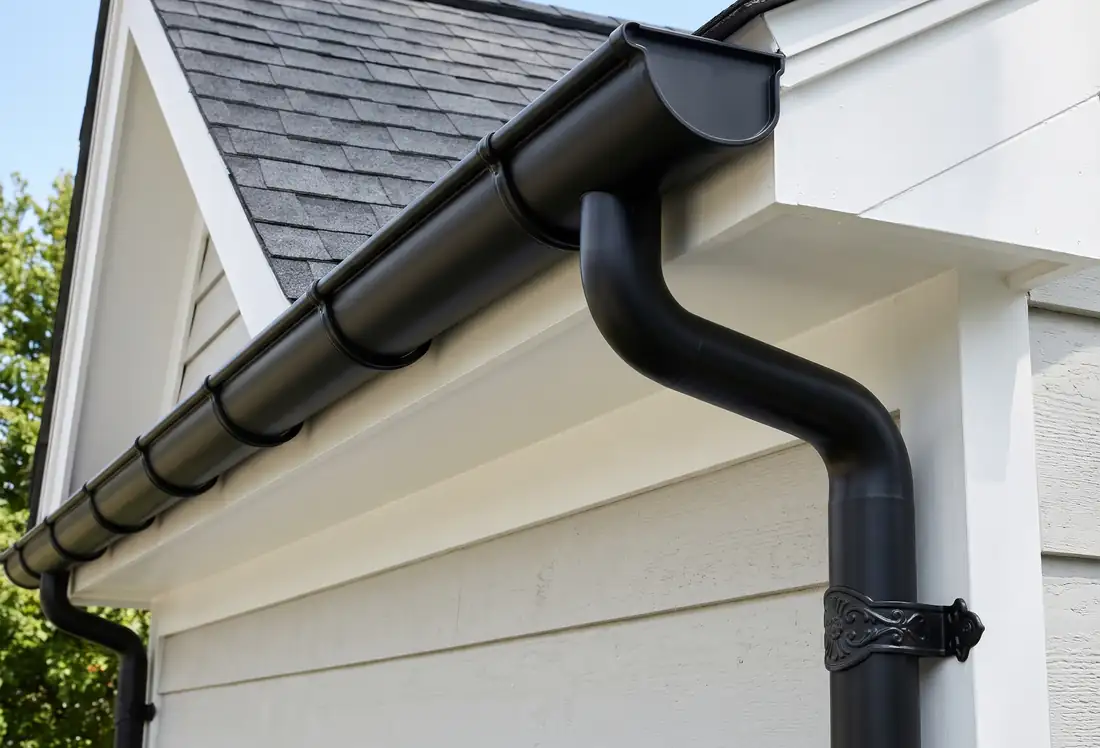
Houses built before about 1940 with open eaves, exposed rafter tails or decorative trim. Bremerton was founded in 1891 and incorporated in 1901, and grew with the shipyard. Older streets in Manette and West Bremerton hold Craftsman bungalows and modest early homes. A K-style gutter covers their rafter tails. Half-round sits below them.
How is half-round different from K-style?
| Half-round | K-style | |
|---|---|---|
| Shape | Half a pipe | Flat back, shaped front |
| Support | Brackets or roof straps | Hidden hangers |
| Capacity at the same width | Less | More |
| Downspout | Round | Rectangular |
| Inside | Smooth curve | Corners where needles lodge |
| Look | Period | Modern |
How is half-round hung?
- Rafter tails and fascia are probed and soft wood repaired
- A string line sets the fall
- Brackets go in about every two feet, on the fascia or each rafter tail
- Lengths are laid in and joined
- End caps and outlets are fitted
- Round downspouts and elbows are strapped to the wall
Where there is no fascia, long straps run up under the roofing to the deck.
| Bracket | Fixes to | Use |
|---|---|---|
| Fascia bracket | The fascia face | Most houses with fascia |
| Shank and rod hanger | Through the fascia | Heavier gutters and copper |
| Roof strap | The roof deck | Open eaves, no fascia |
| Rafter-tail bracket | Side of each tail | Exposed decorative tails |
What size?
Half-round carries less than K-style at the same width, so main roofs usually need 6-inch.
| Roof | Half-round | Round downspout |
|---|---|---|
| Porch or bay | 5-inch | 3-inch |
| Bungalow main roof | 6-inch | 4-inch |
| Large or steep roof | 6-inch with extra outlets | 4-inch |
Which metal?
| Metal | Notes |
|---|---|
| Painted aluminum | Lowest cost, rustproof |
| Galvanized or Galvalume steel | Stiff on brackets, closest to the original look, rusts in time in constant wet |
| Copper | The traditional best, longest lasting |
What about old roof edges?
Wood on a house this old has been through a hundred-odd Puget Sound winters. Corners and the boards under old downspouts are usually the softest. A few early homes had gutters framed into the eave itself; where that lining has failed, the rot can run deep. Brackets only go on once the wood behind them is solid again.
How does half-round cope with fir needles?
Its smooth curve lets needles and grit slide toward the outlet better than K-style. Outlets still clog. Use 4-inch round downspouts, wide outlets and a cleaning schedule. A few mesh guards are made for half-round.
Do historic listings matter?
Some Bremerton buildings are on historic registers. Like-for-like replacement is simplest. Ask the City of Bremerton before changing a street-facing roof edge on a listed property.
How much does it cost?
Expect to pay more than for K-style in the same metal, since brackets, round pipe and the extra labor all add up. Copper half-round is the top of the market, around $29 to $40 a foot by national guides.
Exposed brackets or hidden hangers?
Visible brackets look right on a period facade and match how the house was built. Concealed hangers read as tidier. A common compromise is brackets at the front, hangers round the back.
Can I mix half-round and K-style?
Yes. Half-round on the street front and K-style at the back keeps cost down.
What should a half-round quote say?
- Size, usually 6-inch
- Metal and thickness
- Bracket style and spacing
- Round downspout size
- Roof-edge repairs priced per foot
- Any historic review needed
Does the installer need to be registered?
Washington requires every construction contractor to register with L&I and carry a bond and insurance, with no exemption for small jobs. Look up the registration before you sign.
Half-round gutter terms
| Term | Plain meaning |
|---|---|
| Half-round | A semicircular gutter, the norm on houses built before about 1940 |
| Bracket | A support the gutter sits in, fixed below it. Standard for half-round |
| Rafter tail | The tip of a roof rafter that projects beyond the wall |
| Fascia | The trim board capping the rafter ends, and the thing your gutter is screwed to |
| Outlet | The hole and short tube in the gutter floor where water drops into the downspout |
| Downspout | The vertical pipe taking water down from the gutter. Often called a leader |
| Collector head | A box at the top of a downspout that gathers water from a scupper or from two gutters |
| End cap | The closure at the end of a run |
How are round downspouts finished at the bottom?
With a round elbow and a round extension, or into a tightline through a round-to-square adapter. On a period front, some owners use a cast boot at the base. On sloping Manette lots, a tightline is usually the right finish.
What about houses with cedar shingle roofs?
Some early homes still carry cedar shingles or shakes. Half-round brackets fixed to the fascia leave the roofing alone. Strap hangers that run up under the roofing need care so shingles are not split.
Is half-round right for a waterfront home?
It can be, in copper or aluminum with stainless fixings. It suits craftsman and cottage-style homes along the shore.
How do I check the contractor?
Ask for the Washington L&I registration number, look it up on L&I's verify tool, and ask for a certificate of insurance. Get the scope and price in writing before work starts, and pay in stages rather than all up front.