
On this page
- How do I know gutters are worn out?
- How does this climate wear gutters out?
- What happens during a replacement?
- What upgrades are worth making?
- What does replacement cost?
- Does replacement need a registered contractor?
- How long does it take?
- What else is worth doing while the gutter is down?
- In what order should the work happen?
- Which houses here most often need replacement?
- Can I replace one side at a time?
- Does it help when selling?
- What should I ask before signing?
- Parts in a full replacement
- What happens to the old gutters?
- Can replacement be split across two seasons?
- Does replacement help a wet crawl space?
- How do I check the contractor?
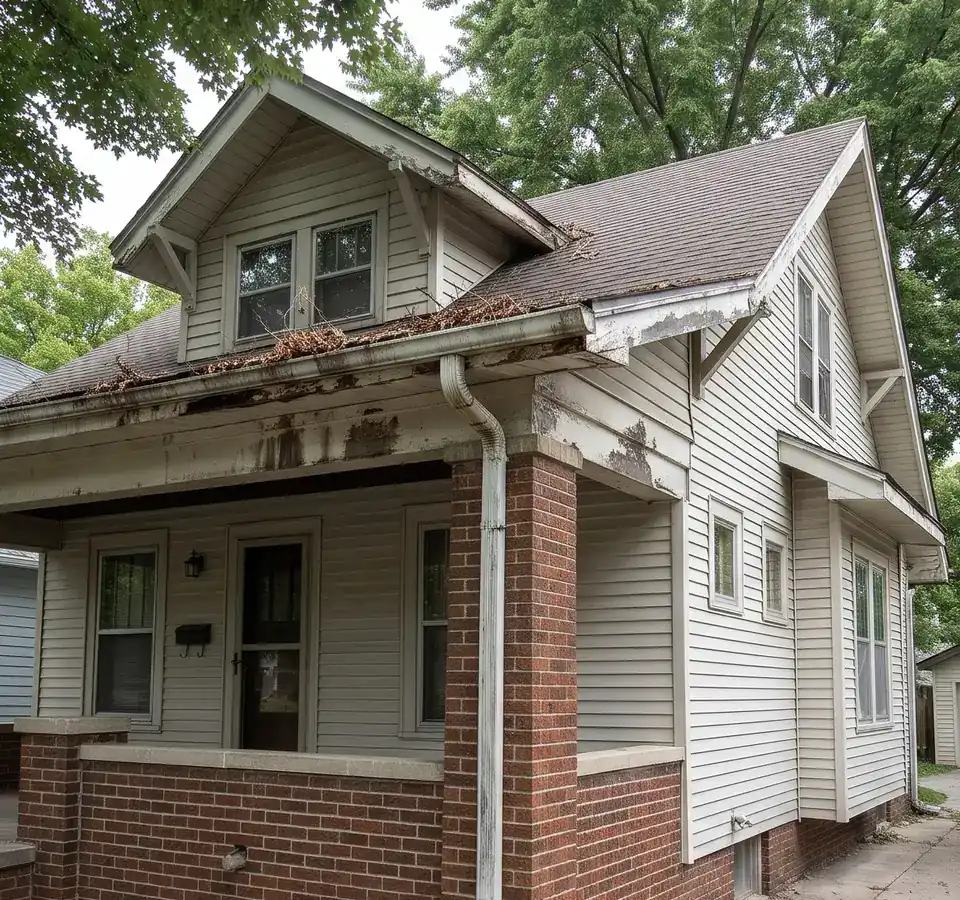
How do I know gutters are worn out?
Look for faults that show up on every wall.
- Leaks at most seams and corners, even after resealing
- Runs that will not hold a straight line
- Fascia soft or stained along whole walls
- Rust on old steel gutters
- Spills in ordinary rain when the gutter is clean
- Old sectional gutter with a seam every ten feet
- Moss growing out of the gutter year after year
One or two on one wall is a repair. Several on every wall points to replacement.
How does this climate wear gutters out?
| Part | What the wet does | What you notice |
|---|---|---|
| Sealant | Breaks down when it is rarely dry | Drips at seams and corners |
| Fascia | Rots behind leaking or overflowing gutters | Soft wood, hangers pulling out |
| Spikes | Lose grip in damp wood | Runs tipping forward |
| Steel | Rusts where coating is scratched | Orange stains and pinholes |
| Paint | Grows algae and moss in shade | Green streaks on the face |
What happens during a replacement?
- Removal. Old gutters, downspouts and spikes come down and are hauled away. Aluminum is usually recycled.
- Wood inspection. With the fascia bare, every foot is checked. Rotten lengths are cut out and replaced, and rafter tails repaired if needed.
- Roof edge. A gutter apron goes in where drip edge is missing.
- New layout. Outlets are placed where water can be led safely away. Runs below valleys may go to 6-inch. Extra downspouts are added on long walls.
- New gutter. Formed and hung as in a new installation.
- Drainage. Extensions, splash blocks or tightlines finish each downspout.
- Test. Water through every run.
What upgrades are worth making?
| Upgrade | Worth it when |
|---|---|
| 0.032-inch aluminum | Trees overhang or the site is windy |
| 3x4 downspouts | Needles and cones kept blocking 2x3s |
| 6-inch gutter | A run overflowed below a valley or long roof |
| Extra outlets | Any run over about 40 feet |
| Hidden hangers | Always |
| Gutter apron | Water was getting behind the old gutter |
| Stainless mesh guards | Firs or cedars overhang |
| Tightlines | Water pooled at the foundation or ran down a slope |
What does replacement cost?
New gutter plus removal and any wood repair. National ranges from Angi and This Old House put 5-inch seamless aluminum at roughly $9 to $14 per installed foot and 6-inch at $11 to $17. Nobody publishes Kitsap-only figures, so treat those as a benchmark rather than a quote. See the Bremerton cost guide.
| Item | Usually charged |
|---|---|
| Gutter and downspouts | Per foot |
| Removal and disposal | Included or a flat fee |
| Fascia | Per foot, as found |
| Gutter apron | Per foot |
| Extra downspouts | Each |
| Tightlines | Per foot |
| Guards | Per foot |
Does replacement need a registered contractor?
Yes. Washington requires every construction contractor to register with L&I and carry a bond and insurance. Look up the number before signing.
How long does it take?
| Stage | Typical time, single-storey house |
|---|---|
| Removal | An hour or two |
| Wood inspection and repair | None to most of a day |
| Forming and hanging | Three to five hours |
| Downspouts and drainage | One to three hours |
| Test and clean-up | Under an hour |
Wet weather, steep lots, two storeys and heavy rot all stretch those times.
What else is worth doing while the gutter is down?
| Job | Worth it if |
|---|---|
| Paint or wrap sound fascia | Paint is failing |
| Replace soffit panels | They are stained, soft or let birds in |
| Fill old spike holes | Always |
| Have a roofer treat roof moss | Moss is thick on the roof |
| Have limbs trimmed back | They touch or overhang the roof |
In what order should the work happen?
- A new roof first, if one is due
- Moss treatment on the roof, if needed
- Fascia and soffit repairs
- Paint the fascia while it is bare
- New gutters and downspouts
- Tightlines and extensions
- Guards, where trees overhang
Which houses here most often need replacement?
Postwar ramblers and split-levels still on sectional or spiked gutters, older homes in Manette and West Bremerton with gutters and fascia that have been patched for decades, and 1980s and 1990s homes whose original gutters now leak at every seam.
Can I replace one side at a time?
Yes. K-style profiles match, though paint color may differ slightly if the old gutter has weathered.
Does it help when selling?
Inspectors note gutters pulling away, overflow stains, rot at the fascia and downspouts emptying at the foundation. A worn-out system is worth replacing before listing so it does not become a negotiating point.
What should I ask before signing?
- Could any runs be repaired instead?
- What changes in the layout, and why?
- What is the per-foot rate for fascia?
- Which metal, thickness and fasteners?
- Is removal included?
- Where will each downspout drain?
- What is your L&I registration number?
Parts in a full replacement
| Term | Plain meaning |
|---|---|
| K-style | The everyday gutter profile, flat at the back with a decorative front. Also called ogee |
| Fascia | The trim board capping the rafter ends, and the thing your gutter is screwed to |
| Drip edge | A strip of bent metal under the first row of shingles. Its lip throws runoff clear of the board and into the trough |
| Gutter apron | Flashing with a long leg under the shingles and a short leg dropping inside the gutter, so nothing runs down behind |
| Hidden hanger | A metal bracket that hooks under the gutter lip and is driven into the fascia with a long screw, out of sight |
| Spike and ferrule | The old fixing: a long nail through a sleeve, straight through the gutter face. It loosens in wet wood |
| Outlet | The hole and short tube in the gutter floor where water drops into the downspout |
| Downspout | The vertical pipe taking water down from the gutter. Often called a leader |
| Elbow | An angled fitting on a downspout. A-style bends toward or away from the wall; B-style bends along it |
| Tightline | A buried solid pipe taking roof water to an approved outlet away from the house |
What happens to the old gutters?
They are hauled away. Aluminum and copper are usually recycled. Steel is worth less. Vinyl goes to landfill.
Can replacement be split across two seasons?
Yes. Many owners replace the worst walls before the wet season and the rest the next summer. Ask for both phases on one quote so profile and color match.
Does replacement help a wet crawl space?
It helps when the new layout carries roof water well away from the foundation, with tightlines where needed. New gutters alone, with downspouts emptying at the wall, will not.
How do I check the contractor?
Ask for the Washington L&I registration number and look it up on L&I's verify tool. Ask for a certificate of insurance, and get the work and price in writing before anything starts.