
On this page
- How is seamless gutter made?
- Why do fewer seams matter on the peninsula?
- What does a seamless install involve?
- Which corner should I ask for?
- What sizes, metals and colors?
- What does seamless cost?
- Are there limits?
- How do I check a finished job?
- Which houses gain most?
- Does the installer need to be registered?
- What should I ask?
- Words on a seamless gutter quote
How is seamless gutter made?
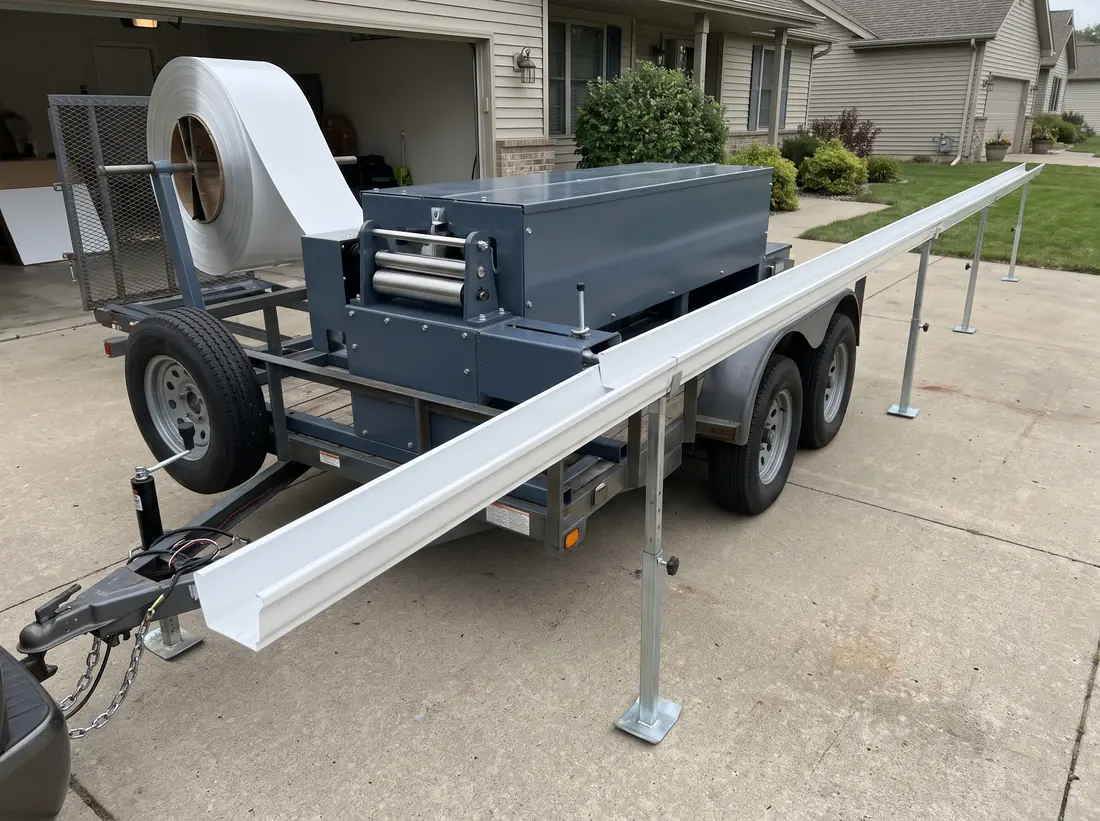
A forming machine rides on the installer's truck or trailer. Painted aluminum coil feeds into one end, rollers fold it into the K-style shape, and the gutter comes out the other end for as long as the crew lets it run. A 46-foot wall gets one 46-foot length. Sectional gutter, by contrast, comes in ten-foot pieces joined on the house.
Why do fewer seams matter on the peninsula?
Because seams are where gutters leak, and here they are wet for months. Bremerton gets roughly 57 inches of precipitation a year, much of it from October to April in long, steady spells. Sealant in a joint that rarely dries breaks down faster, and every seam is a place for a drip to start and for water to wick behind onto the fascia. A sectional run on a 46-foot wall has four seams along its length. A seamless one has none.
What does a seamless install involve?
- Old gutters, spikes and straps come off and the fascia is tested for rot
- Soft fascia is cut out and replaced with primed board
- A gutter apron goes under the shingles if there is no drip edge
- A chalk line sets the fall toward each outlet
- Each wall's length is formed, trimmed and laid on sawhorses
- Outlets are cut in and end caps sealed on the ground
- The crew lifts the run and screws it up through hidden hangers every two feet or closer
- Corners are cut, riveted and sealed inside
- Downspouts are strapped on and led to an extension, splash block or tightline
- A hose run at the high end proves the fall
Which corner should I ask for?
| Corner | How it is made | Seams | Notes |
|---|---|---|---|
| Hand-cut miter | Cut and folded from the gutter itself | One | Neatest, smooth inside, nothing for needles to catch on |
| Strip miter | Two angled cuts under a metal strip | One | Quick and common |
| Box miter | Factory corner both runs slide into | Two | Twice the sealant to fail |
What sizes, metals and colors?
| Option | Notes for a Kitsap house |
|---|---|
| 5-inch K-style | Suits most ramblers and smaller roofs |
| 6-inch K-style | For long or steep roofs and runs below valleys |
| Aluminum, 0.032 inch | Recommended under trees and in windy spots |
| Copper | Can be roll-formed, less common |
| Dark bronze, forest green, slate gray | Popular on peninsula homes, hide moss staining well |
| White and almond | Show algae and needle stains sooner |
What does seamless cost?
Angi and This Old House publish national installed ranges of about $9 to $14 per foot for 5-inch seamless aluminum and $11 to $17 for 6-inch. They are a benchmark for the whole country, not a Kitsap quote. Steep lots, two-storey walls and fascia repair raise it. See the Bremerton cost guide and seamless vs sectional.
Are there limits?
Very long runs, around 40 feet and over, should fall to outlets at both ends or include an expansion joint. The truck needs room near the house to run out the longest length, which can be tricky on a narrow, steep driveway. Half-round profiles need a different machine.
How do I check a finished job?
- No seams along any wall
- Hangers every two feet or closer
- A visible fall toward each downspout
- Corners sealed neatly inside
- Every downspout ending on an extension, splash block or tightline
- Water from a hose reaching each outlet with nothing standing
Which houses gain most?
| House | Why seamless helps |
|---|---|
| Long rambler | Walls of 50 feet or more would carry four or five seams in sectional |
| House under firs and cedars | No seams inside for needles to catch on |
| Two-storey or hillside house | Upper runs are costly to revisit for leaks |
| Waterfront home | Fewer joints for salt-laden rain to work into |
Does the installer need to be registered?
Washington requires every construction contractor to register with L&I and carry a bond and insurance, with no exemption for small jobs. Look up the registration before you sign.
What should I ask?
- Do you form the gutter at my house, in 5 and 6-inch?
- What thickness of coil?
- Which corners?
- Where will each downspout drain?
- How will you handle runs over 40 feet?
- What is your L&I registration number?
Words on a seamless gutter quote
| Term | Plain meaning |
|---|---|
| Coil | The roll of painted sheet metal that the seamless machine shapes into gutter |
| K-style | The everyday gutter profile, flat at the back with a decorative front. Also called ogee |
| Hidden hanger | A metal bracket that hooks under the gutter lip and is driven into the fascia with a long screw, out of sight |
| Hand-cut miter | A corner shaped on site from the gutter itself, riveted and sealed, with one joint |
| Box miter | A ready-made corner that two runs slot into, leaving two joints |
| End cap | The closure at the end of a run |
| Outlet | The hole and short tube in the gutter floor where water drops into the downspout |
| Fall | The gentle downhill slope built into a gutter, roughly a quarter inch every ten feet |
| Expansion joint | A flexible break in a long run that lets the metal move with temperature |