
On this page
- Where does copper make sense on the peninsula?
- What does copper cost?
- 16-ounce or 20-ounce?
- How is copper installed?
- How does copper weather here?
- Does copper resist moss?
- What has to be planned?
- How long does copper last?
- What should a copper quote spell out?
- Does the installer need to be registered?
- Copper gutter terms
- Can copper be added to an aluminum system?
- How does copper handle fir needles?
- What about copper on cedar-sided homes?
- Is copper worth it on a rental?
- How do I check the contractor?
Where does copper make sense on the peninsula?
On early twentieth-century homes in Manette and West Bremerton, on custom homes on Bainbridge Island and around Gig Harbor, on waterfront houses where the gutter is part of the design, and on churches and civic buildings. Many owners use copper where it is seen, over the entry, a porch or a bay window, and painted aluminum elsewhere.
What does copper cost?
Copper is the premium option: around $29 to $40 per installed foot in national guides, roughly triple aluminum. For 160 feet of gutter that is something like $4,640 to $6,400, compared with $1,440 to $2,720 in aluminum on the same basis. Treat those as arithmetic, not quotes. Because copper follows commodity prices, expect a quote to be valid for only a few weeks.
| Painted aluminum | Copper | |
|---|---|---|
| National installed price | $9 to $17 a foot | $29 to $40 a foot |
| Typical life | Twenty years or more | Several times that |
| Seams | Sealed | Soldered |
| Look over time | Holds its paint color | Bright, then brown, then green |
| Upkeep | Reseal seams in time | Little beyond cleaning |
16-ounce or 20-ounce?
Copper is sold by weight per square foot. 16-ounce is standard for house gutters. 20-ounce is stiffer, for wide profiles, long unsupported spans and built-in gutter linings.
How is copper installed?
- Brackets go onto the fascia or rafter tails along a taut string set to the right slope
- Copper lengths drop into the brackets with overlapping ends
- Each overlap, cap and outlet is cleaned, fluxed and soldered watertight
- Long runs get a slip joint so the metal can move
- Round copper downspouts are held with copper or brass bands
- Where two gutters meet one downspout, a collector head goes on top
Soldering takes time. A house done in a day in aluminum may take two or three in copper, and soldering waits for dry weather.
How does copper weather here?
Faster than in dry climates. New copper dulls to brown within months. With roughly 57 inches of precipitation a year and salt air near the water, the blue-green patina can develop within years rather than decades. The patina protects the metal underneath. No polish or sealer is needed.
Does copper resist moss?
Copper is often said to discourage moss and algae, and runoff from copper roof strips is used for that reason. A copper gutter still fills with needles and leaves and still needs cleaning.
What has to be planned?
| Issue | How to handle it |
|---|---|
| Mixing metals | Copper or brass fixings. Keep aluminum and galvanized steel out of contact and out of copper runoff |
| Staining | Lead every outlet into a downspout and discharge away from light siding and concrete |
| Historic properties | Ask the city before changing a street-facing roof edge on a listed building |
| Theft | Tamper-resistant fasteners on ground-level downspouts |
How long does copper last?
Many decades. It does not rust. Systems are usually replaced because of damage or failed solder, not wear.
What should a copper quote spell out?
- Weight, 16 or 20-ounce
- Profile and size
- Soldered seams
- Bracket style, metal and spacing
- Expansion joint positions
- Downspout size and strap metal
- How long the price holds
- The contractor's L&I registration number
Does the installer need to be registered?
Washington requires every construction contractor to register with L&I and carry a bond and insurance, with no exemption for small jobs. Look up the registration before you sign.
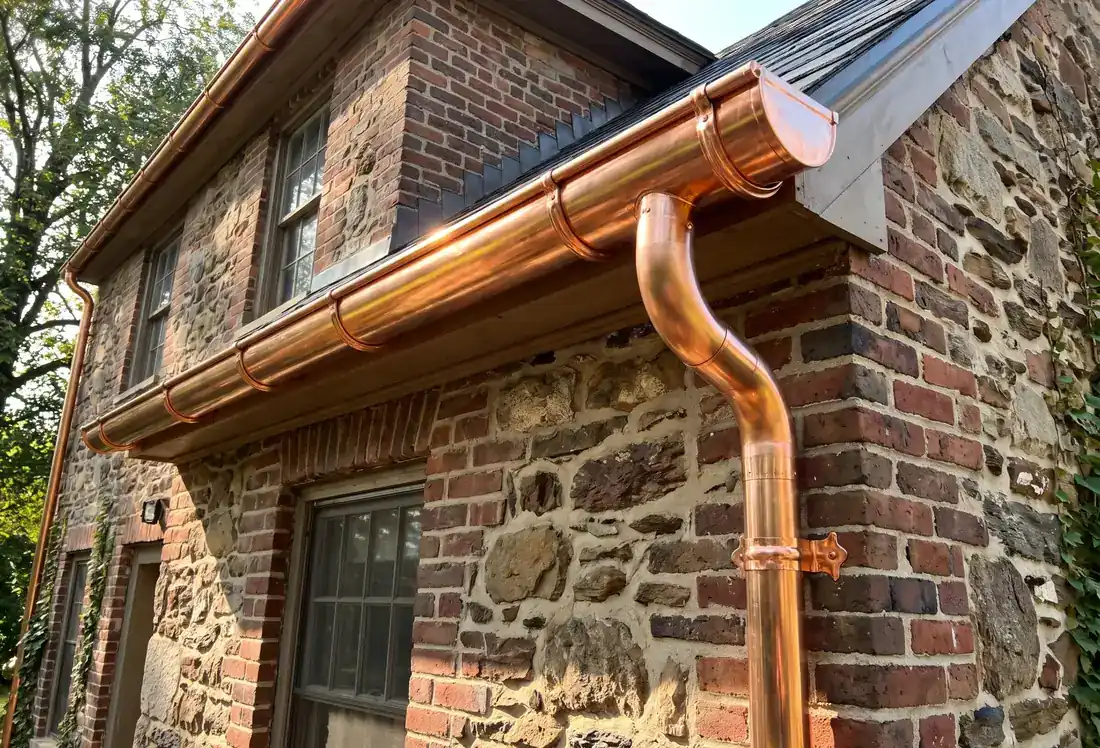
Copper is most often made in half-round.
Copper gutter terms
| Term | Plain meaning |
|---|---|
| Gauge | How thick the metal is. Aluminum house gutter is 0.027 or 0.032 inch; copper is sold as 16 or 20 ounce |
| Half-round | A semicircular gutter, the norm on houses built before about 1940 |
| Bracket | A support the gutter sits in, fixed below it. Standard for half-round |
| Collector head | A box at the top of a downspout that gathers water from a scupper or from two gutters |
| Outlet | The hole and short tube in the gutter floor where water drops into the downspout |
| Downspout | The vertical pipe taking water down from the gutter. Often called a leader |
| Expansion joint | A flexible break in a long run that lets the metal move with temperature |
Can copper be added to an aluminum system?
It can be done on its own run, over the entry for instance, provided copper and aluminum never touch and no copper runoff falls onto aluminum. The switch normally happens at a corner or downspout, with a plastic or rubber break between them.
How does copper handle fir needles?
Like any gutter, it fills. Copper half-round's smooth curve lets needles slide toward the outlet a little better than K-style. Use 4-inch round downspouts and a cleaning schedule, or a mesh guard made for half-round.
What about copper on cedar-sided homes?
Copper weathers in harmony with cedar and is a common pairing on custom homes on Bainbridge Island and around Gig Harbor. Keep copper runoff off light concrete and stone, which it can tint.
Is copper worth it on a rental?
Rarely. Painted aluminum is cheaper to fit and repair.
How do I check the contractor?
Ask for the Washington L&I registration number, look it up on L&I's verify tool, and ask for a certificate of insurance. Get the scope and price in writing before work starts, and pay in stages rather than all up front.