
On this page
- How many downspouts does a house need?
- Which size?
- How is a downspout put up?
- What are A and B elbows?
- Where should the water go?
- Are there local rules?
- How is a tightline laid?
- What goes wrong most often?
- What does adding or moving one cost?
- Should downspouts match the siding?
- Downspout and drainage terms
- Should downspouts go into my footing drain?
- What about downspouts on split-levels?
- How do I check the contractor?
How many downspouts does a house need?
Allow one per 30 to 40 feet of run and one beside every valley. Long wet spells and needle-choked outlets make spare capacity worthwhile, and an extra downspout is one of the cheapest overflow cures there is.
Which size?
| Downspout | Usually paired with | Notes |
|---|---|---|
| 2x3 inch | 5-inch gutter | About 600 sq ft of roof. Jams on cones and maple leaves |
| 3x4 inch | 6-inch gutter, or any gutter under trees | About twice the flow |
| 3 or 4-inch round | Half-round | Period houses |
How is a downspout put up?
- An outlet spot is picked where water can be led away safely
- The outlet hole is cut and the drop sealed in
- Elbows bring the pipe back to the wall
- Pipe is cut so each upper piece fits inside the one below
- Straps go in at the top, the bottom and every six to eight feet
- A bottom elbow turns water to an extension, splash block or tightline
What are A and B elbows?
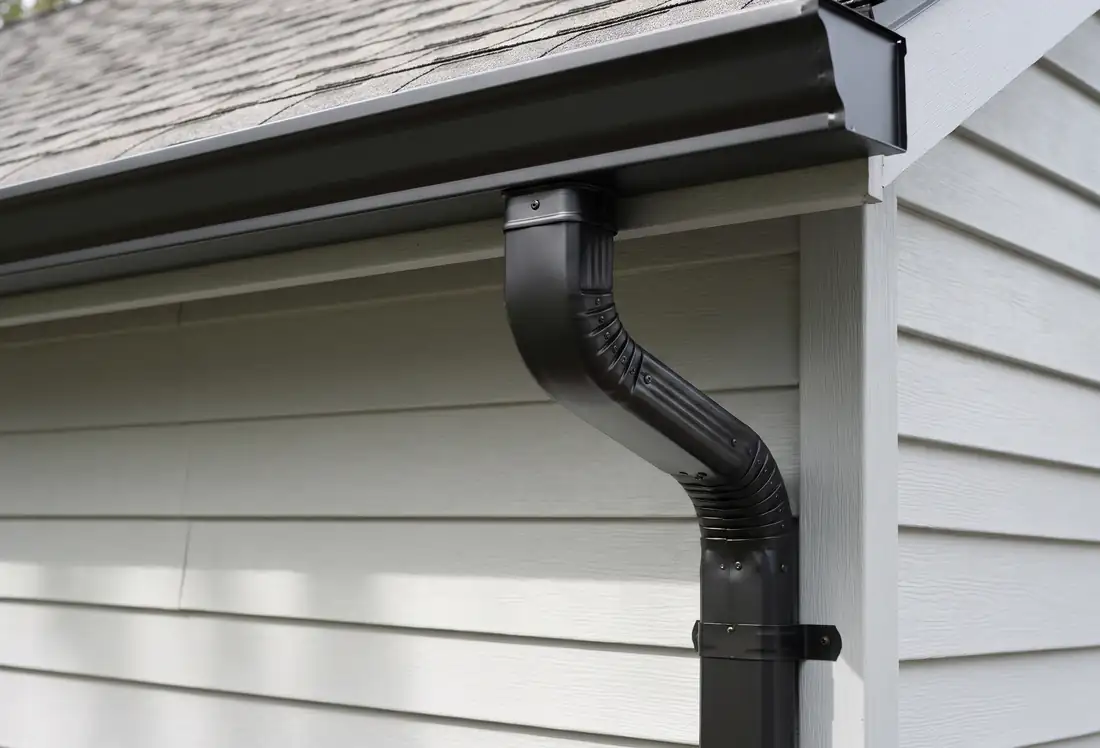
An A-style elbow turns toward or away from the wall. A B-style elbow turns sideways along it, to get round a window or door. Most downspouts use two A elbows at the top and one at the bottom.
Where should the water go?
Away from the foundation, onto ground that falls away, or into a solid pipe to an approved outlet. Many Kitsap lots slope steeply toward the water, and much of the ground holds water through the wet season. A downspout emptying at the wall soaks the soil next to the foundation for months. One emptying onto a bank can wash it out.
| Discharge | Suits | Watch for |
|---|---|---|
| Splash block | Ground already falling away | Not enough on its own in this rainfall |
| Rigid extension, 6 feet or more | Most walls | Moved for mowing and left off |
| Tightline to an approved outlet | Hillsides, wet ground, paths in the way | Needs steady fall and a cleanout |
| Line to a rain garden | Yards with room and soil that drains | Sized and sited for the roof area |
| Rain barrel or cistern | Garden use in the dry summer | Fills in minutes in winter. The overflow needs a route |
| Drywell | Lots with no outlet | Must suit the soil. Ask the city or county first |
Are there local rules?
Yes. Roof water is stormwater, and cities and counties around Puget Sound regulate where it goes, especially on slopes and near shorelines. Connecting to a storm drain or the street, building a drywell or discharging toward a bluff can need approval. Ask the City of Bremerton, your own city or Kitsap County first.
How is a tightline laid?
- Call 811 so utilities are marked
- Plan a route that falls all the way to the approved outlet
- Lay smooth-wall solid pipe, not thin corrugated
- Fit a cleanout where the downspout joins
- Protect the outlet so it does not erode a bank
- Test with a hose before backfilling
What goes wrong most often?
- Downspouts ending at the foundation or by a crawl-space vent
- Extensions removed and never put back
- Buried lines crushed or full of needles and silt
- Water sent down a slope that is starting to erode
- Straps pulled out by wind
- Downspouts emptying onto a path that freezes on cold mornings
See downspout repair.
What does adding or moving one cost?
Nobody publishes local rates. A new downspout means a cut outlet, a few elbows, some pipe, straps and an extension, so it is a modest job. Relocating one also means patching where it was. Buried lines are charged by the foot.
Should downspouts match the siding?
Many owners match the downspout to the siding so it disappears and the gutter to the trim.
Downspout and drainage terms
| Term | Plain meaning |
|---|---|
| Downspout | The vertical pipe taking water down from the gutter. Often called a leader |
| Outlet | The hole and short tube in the gutter floor where water drops into the downspout |
| Elbow | An angled fitting on a downspout. A-style bends toward or away from the wall; B-style bends along it |
| Strap | A band holding the downspout against the wall |
| Splash block | A ribbed pad that spreads water where a downspout ends |
| Extension | A length of pipe added at the bottom to carry water farther from the house |
| Cleanout | A removable cap at the point where a downspout meets an underground line |
| Tightline | A buried solid pipe taking roof water to an approved outlet away from the house |
See also downspout drainage and your foundation.
Should downspouts go into my footing drain?
Usually not. Footing drains collect groundwater. Adding roof water can overwhelm them. Keep roof water in a separate tightline.
What about downspouts on split-levels?
An upper roof that drains onto a lower roof doubles the water reaching the lower gutter. A downspout from the upper gutter can be led down to ground level instead, past the lower roof, so the lower gutter only carries its own roof.
How do I check the contractor?
Ask for the Washington L&I registration number, look it up on L&I's verify tool, and ask for a certificate of insurance. Get the scope and price in writing before work starts, and pay in stages rather than all up front.