
On this page
- How do windstorms damage gutters here?
- How bad have the storms been?
- Which trees are the usual culprits?
- What should I do once the wind drops?
- How is a limb-damaged gutter repaired?
- Can a creased gutter be straightened?
- Is it storm damage or old age?
- What do insurers usually cover?
- What photos help most?
- What about contractors who knock on doors?
- How urgent is each kind of damage?
- How can I reduce damage next winter?
- Does the repair contractor need to be registered?
- Parts that take storm damage
- How do I check the contractor?
How do windstorms damage gutters here?
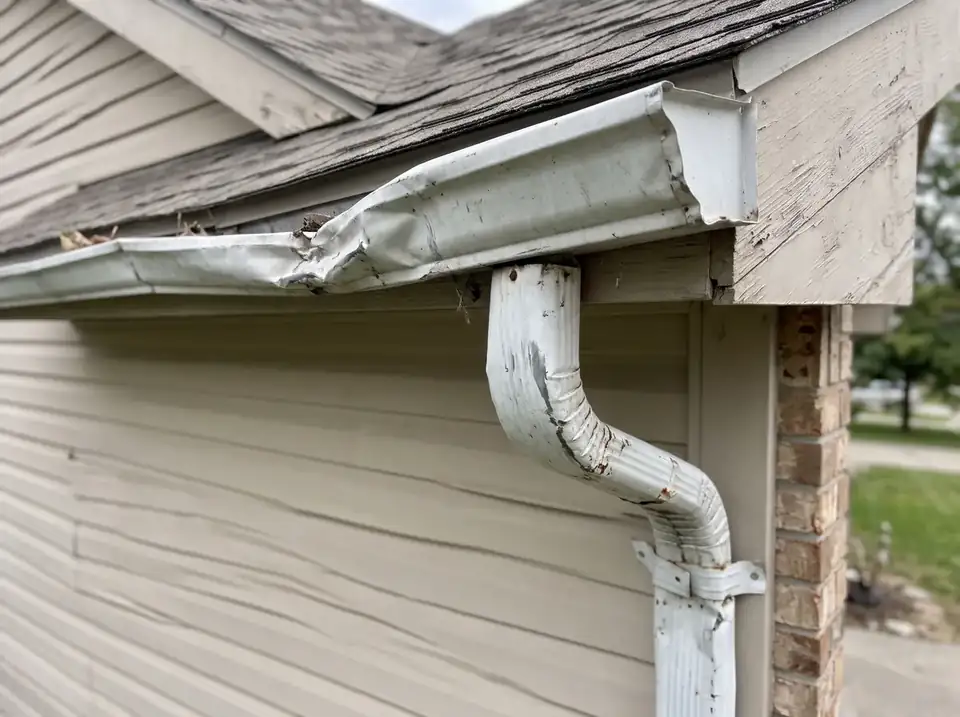
Pacific fronts arrive through fall and winter with strong south and southwest winds. Kitsap lots are crowded with Douglas fir, bigleaf maple and alder, many taller than the houses beneath them. When gusts pick up, limbs come down. A limb landing on the roof edge creases the gutter, snaps hangers and can rip a downspout off the wall. Wind alone also lifts loose runs and strips long downspouts that were held by too few straps.
How bad have the storms been?
The Hanukkah Eve windstorm of December 2006 is the one many residents remember: gusts of 50 to 80 mph and more across interior Puget Sound, about 1.2 million Washington customers without power and 18 deaths across the region. Most winters are milder, but each brings a few fronts strong enough to drop limbs on roofs somewhere on the peninsula.
Which trees are the usual culprits?
| Tree | Typical failure | What it does to a gutter |
|---|---|---|
| Douglas fir | Sheds limbs and sometimes the top | Creases, crushed sections, torn hangers |
| Bigleaf maple | Drops heavy branches, especially when wet | Deep creases, broken downspouts |
| Red alder | Can fail whole in saturated ground | Roof and gutter damage together |
| Western red cedar | Sheds sprays and small limbs | Mostly debris, some dents |
| Madrone | Sheds limbs and bark | Dents and blocked outlets |
What should I do once the wind drops?
- Keep well away from any downed power line and report it
- Walk the outside of the house and look up at each roof edge
- Photograph every side before anything is moved
- Look for limbs on the roof, not just in the gutter
- Check downspouts and the ground where they drained
- Make safe what you can reach from the ground
- Call your insurer if the damage is more than a dent or two
How is a limb-damaged gutter repaired?
The limb comes off first, ideally by an arborist if it is large or still caught in the tree. The creased run is taken down. With the fascia exposed, the contractor checks it for splits and soft wood, since an impact often cracks the board. A new length is formed to match the profile and, as closely as possible, the color. It goes up on new hidden hangers and is joined to the sound gutter at a corner or a sealed lap. Downspouts are refitted with more straps than before.
Can a creased gutter be straightened?
No. Once metal is creased, water pools at the crease and the seam it makes will leak. Shallow round dents with no crease can stay if they do not hold water.
Is it storm damage or old age?
Insurers ask this, and so should you. Storm damage is sudden and local: a crease where a limb hit, a run torn off on the windward side, a downspout ripped away. Wear is gradual and widespread: sagging over months, seams leaking on every wall, fascia rotting behind the gutter. A contractor's written note on the cause helps with a claim.
What do insurers usually cover?
Policies differ. Sudden damage from wind or a falling tree is commonly covered, less the deductible. Rot, worn sealant and neglect are not. You choose the contractor; the adjuster decides what the policy pays.
What photos help most?
- Wide shots of each side of the house
- The limb where it landed
- Close-ups of creases, torn hangers and split fascia
- Downspouts and the ground below them
- The roof edge and any shingle damage above the gutter
What about contractors who knock on doors?
They appear after every big storm. Ask for a Washington L&I registration number and check it before agreeing to anything. Do not sign over insurance proceeds on the doorstep, and do not pay in full before the work is done.
How urgent is each kind of damage?
| Damage | How soon to fix |
|---|---|
| A run hanging by one end | Straight away, it can fall |
| Downspout off, water pouring at the foundation | Within days |
| Creased run spilling | Before the next front |
| Shallow dents, no leak | Whenever convenient |
| Shingles damaged above the gutter | Roofer first |
How can I reduce damage next winter?
- Have an arborist look at the trees over the roof in summer
- Remove dead wood and thin heavy limbs
- Use 0.032-inch aluminum, which resists creasing better
- Space hidden hangers at two feet or closer
- Strap downspouts every six to eight feet
- Keep gutters clean so they are light when the wind comes
Does the repair contractor need to be registered?
Washington's contractor registration law requires every construction contractor to be registered with L&I, bonded and insured, whatever the size of the job. The L&I lookup shows whether a registration is current.
See windstorms, wet seasons and gutters for a season plan.
Parts that take storm damage
| Term | Plain meaning |
|---|---|
| Hidden hanger | A metal bracket that hooks under the gutter lip and is driven into the fascia with a long screw, out of sight |
| Fascia | The trim board capping the rafter ends, and the thing your gutter is screwed to |
| Downspout | The vertical pipe taking water down from the gutter. Often called a leader |
| Strap | A band holding the downspout against the wall |
| Elbow | An angled fitting on a downspout. A-style bends toward or away from the wall; B-style bends along it |
| Drip edge | A strip of bent metal under the first row of shingles. Its lip throws runoff clear of the board and into the trough |
| End cap | The closure at the end of a run |
How do I check the contractor?
Ask for the Washington L&I registration number, look it up on L&I's verify tool, and ask for a certificate of insurance. Get the scope and price in writing before work starts, and pay in stages rather than all up front.