
On this page
- What goes wrong with downspouts?
- How do you clear a blocked downspout?
- Why does mine keep clogging?
- How should a downspout be assembled?
- How are tightlines repaired?
- Why do tall downspouts fail?
- When should a downspout be moved?
- When does it need replacing?
- How can I protect the bottom section?
- What do downspout repairs cost?
- What should I tell the contractor?
- Does the contractor need to be registered?
- Downspout parts
- Can I clear a downspout myself?
- What about downspouts that freeze?
- Why does my downspout gurgle or overflow at the top?
- How do I check the contractor?
What goes wrong with downspouts?
| Problem | Usual cause | Fix |
|---|---|---|
| Gutter spills above the downspout | Needles and cones plugging the outlet or first elbow | Clear and flush. Fit a wide outlet or guard if it recurs |
| Water spraying from a joint | Sections fitted upside down or pulled apart | Re-assemble, upper piece inside lower |
| Pipe hanging off the wall | Straps pulled out by wind or rotted siding | New straps into sound wood |
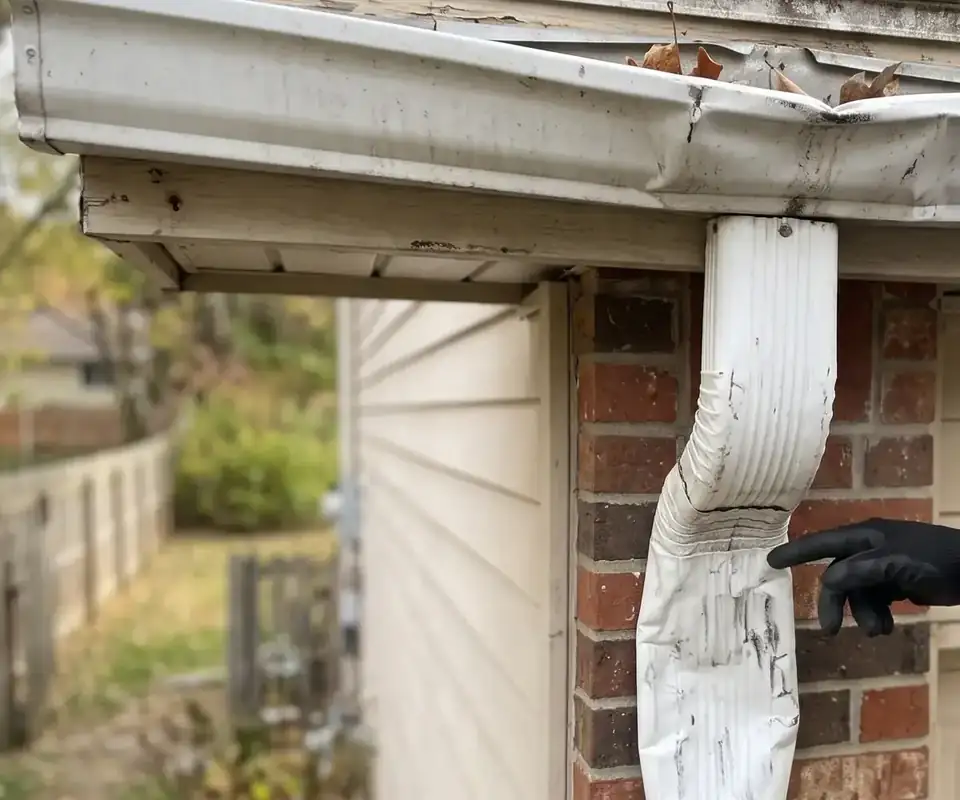
| Flattened at the bottom | Mower, bin or car | New bottom section and elbow |
| Water pooling at the base | No extension, or a blocked tightline | Add an extension or clear the line |
How do you clear a blocked downspout?
- Pull debris from the top of the outlet by hand
- Run a hose down from the top
- If it backs up, tap along the pipe to find the plug
- Remove the bottom elbow and clear it
- For a plug mid-pipe, unstrap the downspout and push it through
- Reassemble, screw each joint and test
Why does mine keep clogging?
The outlet is too small for what falls. Fir cones and maple leaves bridge a 2x3 outlet easily, and needles pack behind them. The lasting answer is a wide-mouth outlet, a 3x4 downspout, or fine mesh over the gutter.
How should a downspout be assembled?
- Each upper piece slides inside the one below
- Every joint gets two screws or rivets
- Elbows bring the pipe back to the wall
- Straps hold it at top, bottom and between
- A bottom elbow turns water away
- An extension or tightline finishes it
Downspouts assembled upside down leak at every joint.
How are tightlines repaired?
| Problem | Repair |
|---|---|
| Needles and silt | Flush from the cleanout |
| Roots | Snake it, replace that length if roots return |
| Crushed pipe | Dig up and relay in solid pipe |
| Lost or eroding outlet | Find it, clear it, protect it |
| No fall | Relay to a steady slope |
Water bubbling up at the foot of the downspout, or a soggy strip along the line's route, means it has failed.
Why do tall downspouts fail?
Tall pipes have more joints, more straps to fail and more wind on them, and a blockage high up is hard to reach. Fit 3x4 pipe, strap it every six to eight feet and put two screws in each joint.
When should a downspout be moved?
When it empties onto a path, a deck, a slope or near a crawl-space vent, or anywhere water cannot be led away safely.
When does it need replacing?
If it is flattened, split, dented along its length or simply too small. A new length is cheap, and replacing it is a good time to move up to 3x4 with a cleanout.
How can I protect the bottom section?
Fit a heavy-duty bottom length, use a hinged extension you can lift out of the way, or send the water into a buried line.
What do downspout repairs cost?
| Job | Relative cost |
|---|---|
| Clearing a blockage | Low |
| Refitting straps | Low |
| New bottom section | Low |
| Wide-mouth outlet | Low |
| Upsizing to 3x4 | Low to medium |
| Tightline repair | Medium, per foot |
What should I tell the contractor?
Which downspout, what happens in rain, whether it goes underground, and what the wall is made of.
Does the contractor need to be registered?
Yes for repairs. Washington requires every construction contractor to register with L&I and carry a bond and insurance, with no exemption for small jobs. Look up the registration before you sign. Afterward, check where the water ends up. See downspouts and drainage.
Downspout parts
| Term | Plain meaning |
|---|---|
| Downspout | The vertical pipe taking water down from the gutter. Often called a leader |
| Outlet | The hole and short tube in the gutter floor where water drops into the downspout |
| Elbow | An angled fitting on a downspout. A-style bends toward or away from the wall; B-style bends along it |
| Strap | A band holding the downspout against the wall |
| Cleanout | A removable cap at the point where a downspout meets an underground line |
| Tightline | A buried solid pipe taking roof water to an approved outlet away from the house |
| Splash block | A ribbed pad that spreads water where a downspout ends |
| Extension | A length of pipe added at the bottom to carry water farther from the house |
Can I clear a downspout myself?
On a single storey, usually. Pull debris from the top by hand, run a hose down, and remove the bottom elbow if water backs up. Leave tall downspouts, tightlines that need digging and anything near power lines to a contractor.
What about downspouts that freeze?
Bremerton rarely sees hard freezes, but on cold mornings a downspout emptying across a path can leave ice. Lead it away from walkways or into a tightline.
Why does my downspout gurgle or overflow at the top?
A partial block lower down, often needles and moss at the bottom elbow or in the tightline. Flush from the top and the cleanout.
How do I check the contractor?
Ask for the Washington L&I registration number, look it up on L&I's verify tool, and ask for a certificate of insurance. Get the scope and price in writing before work starts, and pay in stages rather than all up front.