
On this page
- Why do Kitsap gutters sag?
- How does a contractor work out the cause?
- How is a run re-hung?
- Why not just drive the spike back in?
- How much fall does a gutter need?
- Why does the end so often droop?
- What about cedar shake roofs?
- Can I re-hang a gutter myself?
- How do I stop it happening again?
- What does re-hanging cost?
- What should the quote say?
- Does the contractor need to be registered?
- Fixings and wood
- How do I check the contractor?
Why do Kitsap gutters sag?
Mostly because of what is in them and what is behind them. A gutter half full of wet fir needles, maple leaves and moss is far heavier than an empty one, and in a wet winter it stays heavy for weeks. Behind it, the fascia board has often been soaked for years by leaking seams or water running behind the gutter, and soft wood cannot hold a nail. Old spike-and-ferrule fixings were never strong to begin with. Add winter gusts and the run starts to drop.
| What gave way | Typical sign |
|---|---|
| Spikes pulled out of the board | The whole run tipping forward |
| A single hanger | A dip in the middle of a run |
| Fascia at a board joint | One end drooping |
| The metal itself | A kink or crease from a ladder or limb |
How does a contractor work out the cause?
They empty the gutter, look along it from a ladder and probe the fascia with a screwdriver every few feet. Firm wood and loose spikes mean a straightforward re-hang. Soft patches mean those lengths of board come out first. Soft wood along a whole wall usually means new fascia, and often new gutter on that wall.
How is a run re-hung?
- The gutter is cleared so it can be lifted and lined up
- A chalk line is struck along the fascia, falling a quarter inch per ten feet toward the outlet
- The run is lifted to the line
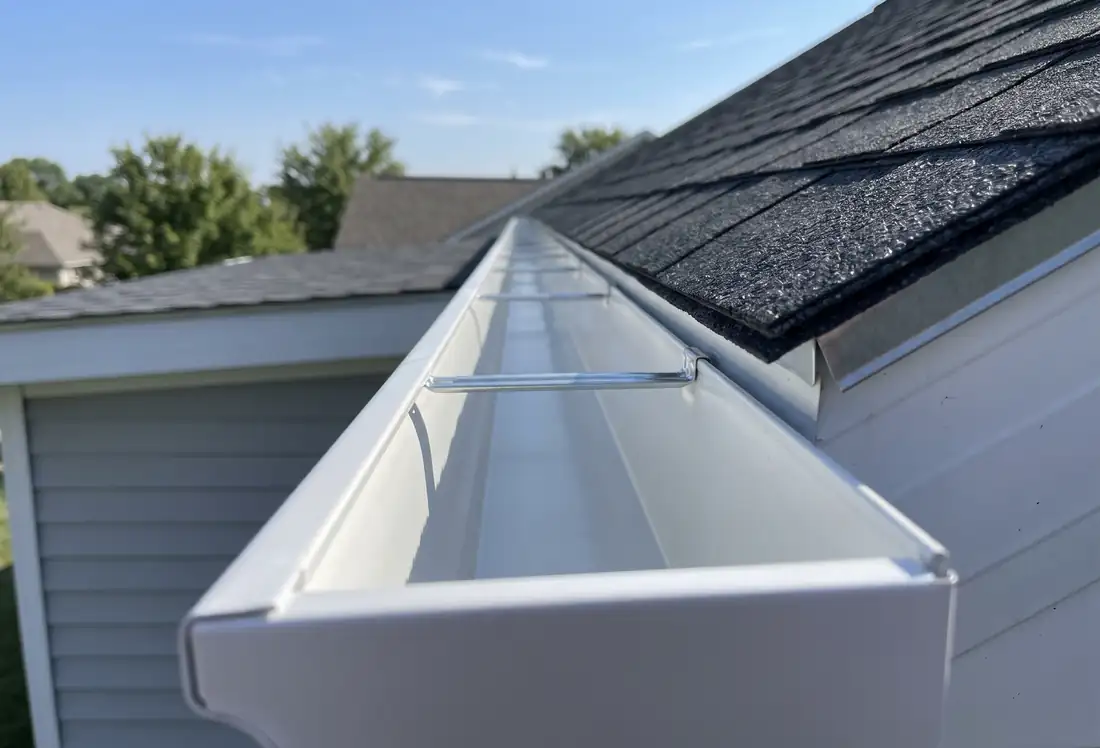
- Hidden hangers clip under the front lip and screw through the back into sound wood, two feet apart or closer
- Old spikes are pulled and their holes sealed
- A hose run shows the water reaching the outlet with nothing standing
Why not just drive the spike back in?
A spike that has backed out once will back out again, usually in the next storm. In soft wood, even a long screw in the old hole does little. The fix is a new fixing in sound wood.
How much fall does a gutter need?
Roughly a quarter inch for every ten feet. Too little and water lies in the trough, feeding moss and rot. Too much and the gutter looks crooked against the roofline. On runs over about 40 feet, the gutter is usually pitched both ways from the middle to an outlet at each end.
Why does the end so often droop?
The end of a run carries the corner and the downspout, and it is often where two fascia boards butt together. End grain soaks up water. Expect soft wood at corners on older Kitsap houses.
What about cedar shake roofs?
Shake roofs often have uneven edges and no drip edge. The gutter must sit where water leaving the shakes drops into it, and a gutter apron may be needed. Crews work from ladders, since shakes split under foot.
Can I re-hang a gutter myself?
On a single-storey run, two people with a sound ladder, a standoff and a box of hidden hangers can do it. Getting the line right takes patience. Stay off wet or mossy roofs, and leave tall walls and steep lots to a contractor.
How do I stop it happening again?
- Keep the trough clear, or fit fine stainless mesh under evergreens
- Fix leaking seams so the fascia can dry
- Add a gutter apron if water runs behind the gutter
- Keep fascia paint sound
- Look along each run every fall for dips
What does re-hanging cost?
It is priced per foot or per run and is one of the cheaper repairs when the wood is sound. Fascia replacement, two-storey walls and steep ground add to it. Get any fascia rate in writing before work starts.
What should the quote say?
- How many feet will be re-hung
- Hanger type and spacing
- Whether old spikes come out and holes are sealed
- A per-foot fascia rate if soft wood is found
- How the fall will be checked
Does the contractor need to be registered?
Washington's contractor registration law requires every construction contractor to be registered with L&I, bonded and insured, whatever the size of the job. The L&I lookup shows whether a registration is current.
See fascia and soffit if the wood is the problem.
Fixings and wood
| Term | Plain meaning |
|---|---|
| Hidden hanger | A metal bracket that hooks under the gutter lip and is driven into the fascia with a long screw, out of sight |
| Spike and ferrule | The old fixing: a long nail through a sleeve, straight through the gutter face. It loosens in wet wood |
| Fascia | The trim board capping the rafter ends, and the thing your gutter is screwed to |
| Rafter tail | The tip of a roof rafter that projects beyond the wall |
| Fall | The gentle downhill slope built into a gutter, roughly a quarter inch every ten feet |
| Bracket | A support the gutter sits in, fixed below it. Standard for half-round |
How do I check the contractor?
Ask for the Washington L&I registration number, look it up on L&I's verify tool, and ask for a certificate of insurance. Get the scope and price in writing before work starts, and pay in stages rather than all up front.