
On this page
- How does micro-mesh work?
- Why does it suit Kitsap trees?
- How is it fitted?
- What makes a good mesh guard?
- How does mesh handle each local tree?
- Does mesh cope with heavy rain?
- Does moss grow on mesh?
- What does it cost?
- What upkeep does it need?
- What are its limits?
- Does the installer need to be registered?
- Guard and gutter terms
- How do I compare two mesh quotes?
- Can I see it working first?
- Does mesh suit a cedar shake roof?
- How do I check the contractor?
How does micro-mesh work?
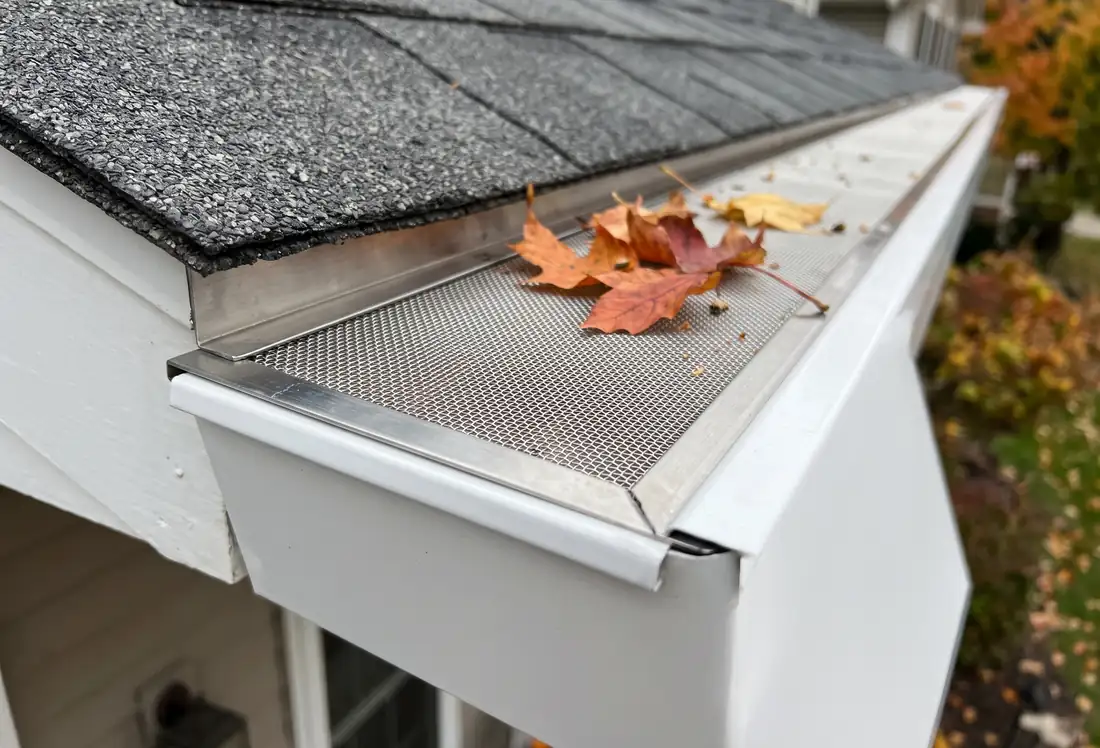
Water clings to the fine wire and drops through. Needles, leaves, seeds and grit stay on top, where rain and wind clear them as they dry. The openings are small enough to stop a fir needle end-on, which coarser guards cannot.
Why does it suit Kitsap trees?
Douglas fir needles are short and stiff. They slide through screen grids and perforations, lodge upright and knit into a mat. Cedar sprays lie flat and dam water. Maple leaves are huge. Only a fine mesh handles all three. And because needles fall all year, a gutter without one under firs never stays clean for long.
How is it fitted?
- Gutters are emptied and flushed
- Sags and loose hangers are fixed and corners resealed
- Mesh panels are cut and screwed along each run
- Corners are mitered and ends closed
- Diverters go below steep valleys
- Water is run across the mesh to prove it drops through
| Fixing method | How | Notes |
|---|---|---|
| Lip and fascia | Front to the gutter lip, back to the fascia or gutter back | Leaves the shingles alone |
| Lip and drip edge | Back tucks under the drip edge | Follows the roof pitch so debris slides off |
What makes a good mesh guard?
| Feature | Why it matters |
|---|---|
| Stainless steel mesh | Will not rust in constant wet |
| Rigid aluminum frame | Stays flat under wet debris |
| Screw fixing | Holds in winter wind |
| A slight pitch | Needles slide off as they dry |
| Closed ends | Keeps out debris, wasps and birds |
| Mesh held mechanically | Glued mesh can lift |
How does mesh handle each local tree?
| Tree | On the mesh | Upkeep |
|---|---|---|
| Douglas fir | Needles sit on top, slide off when dry | Brush off after long still spells |
| Western red cedar | Sprays lie on top | Brush once or twice a year |
| Bigleaf maple | Leaves sit on top and blow off | Little |
| Red alder | Catkins and leaves on top | Rinse in spring |
| Hemlock | Fine needles on top | Occasional brush |
Does mesh cope with heavy rain?
On most roofs, yes. Bremerton's rain is usually steady rather than violent, which suits mesh well. On steep roofs and below valleys, water can skim across in a downpour. Correct pitch and diverters handle it.
Does moss grow on mesh?
In deep, wet shade, moss can start on debris lying on top of the mesh. A brush-off once or twice a year prevents it. Moss on the roof itself needs a roofer.
What does it cost?
More than other types. Contractor-fitted stainless mesh costs several times as much per foot as a basic screen. Brands sold through in-home presentations can cost much more again for a similar product.
| When comparing | Ask about |
|---|---|
| Mesh | Grade of stainless and opening size |
| Frame | Material and thickness |
| Fixing | Screws, clips or adhesive |
| Preparation | Cleaning, re-hanging and resealing first |
| Terms | What happens if the gutter clogs |
| Price | Per foot, fitted |
What upkeep does it need?
A look once or twice a year. Under heavy firs, brush needles off the top after a long dry, still spell. Check ends and corners. Run a hose and watch the downspout. Use a soft brush from a ladder with a standoff, never a pressure washer.
What are its limits?
- A very heavy burst on a steep roof can send some water over
- It does nothing for moss or debris on the roof itself
- It will not fix a gutter with no fall
- It costs the most
Does the installer need to be registered?
Washington requires every construction contractor to register with L&I and carry a bond and insurance, with no exemption for small jobs. Look up the registration before you sign.
Compare cheaper types under screens and reverse-curve guards, and see are gutter guards worth it.
Guard and gutter terms
| Term | Plain meaning |
|---|---|
| Micro-mesh | A guard made from very fine stainless wire cloth on a stiff frame |
| Perforated cover | A guard of aluminum sheet punched with rows of holes |
| Reverse curve | A solid hood guard. Water bends around its rounded nose into a slot |
| Drip edge | A strip of bent metal under the first row of shingles. Its lip throws runoff clear of the board and into the trough |
| Valley diverter | A small metal fin where a valley meets the gutter, breaking up the stream so it does not overshoot |
| Hidden hanger | A metal bracket that hooks under the gutter lip and is driven into the fascia with a long screw, out of sight |
| Moss | The green growth on damp, shaded roofs here. It sheds clumps that dam gutters |
How do I compare two mesh quotes?
Set them side by side and check that both describe the same thing: the grade of stainless and its hole size, the frame, how it is fastened, whether shingles are lifted, whether the gutter is cleaned and repaired first, the per-foot price and the clog terms. A lower figure for a lesser product is not a saving.
Can I see it working first?
Ask the contractor for an address of a job under firs that has been through a winter, or for a sample panel.
Does mesh suit a cedar shake roof?
Yes, fixed to the gutter and fascia so the shakes are left alone.
How do I check the contractor?
Ask for the Washington L&I registration number, look it up on L&I's verify tool, and ask for a certificate of insurance. Get the scope and price in writing before work starts, and pay in stages rather than all up front.